
By Dyuti Khulbe/Public Praxis Forum
If you ask someone what climate change is, chances are they’ll describe it as an environmental problem.
Melting glaciers.
Heatwaves.
Floods.
Wildfires.
Perhaps they’ll mention greenhouse gases, carbon emissions, renewable energy, or the Paris Agreement.
None of those answers are wrong.
But they leave out something interesting.
Today, climate change is no longer discussed only through the language of science. It is increasingly discussed through the language of justice. Governments negotiate not only over emissions but also over fairness. Courts hear climate cases grounded in human rights. Activists demand climate justice. Indigenous communities speak about protecting their lands and ways of life. Small island nations argue that those who contributed least to the problem are paying its highest price.
That wasn’t always the conversation.
For much of the twentieth century, climate change was understood primarily as a scientific and environmental challenge. Scientists tried to understand how the Earth’s climate worked, governments debated how to reduce emissions, and international negotiations focused largely on preventing environmental harm.
So what changed?
When did climate change become more than an environmental problem?
When did it become a question of justice?
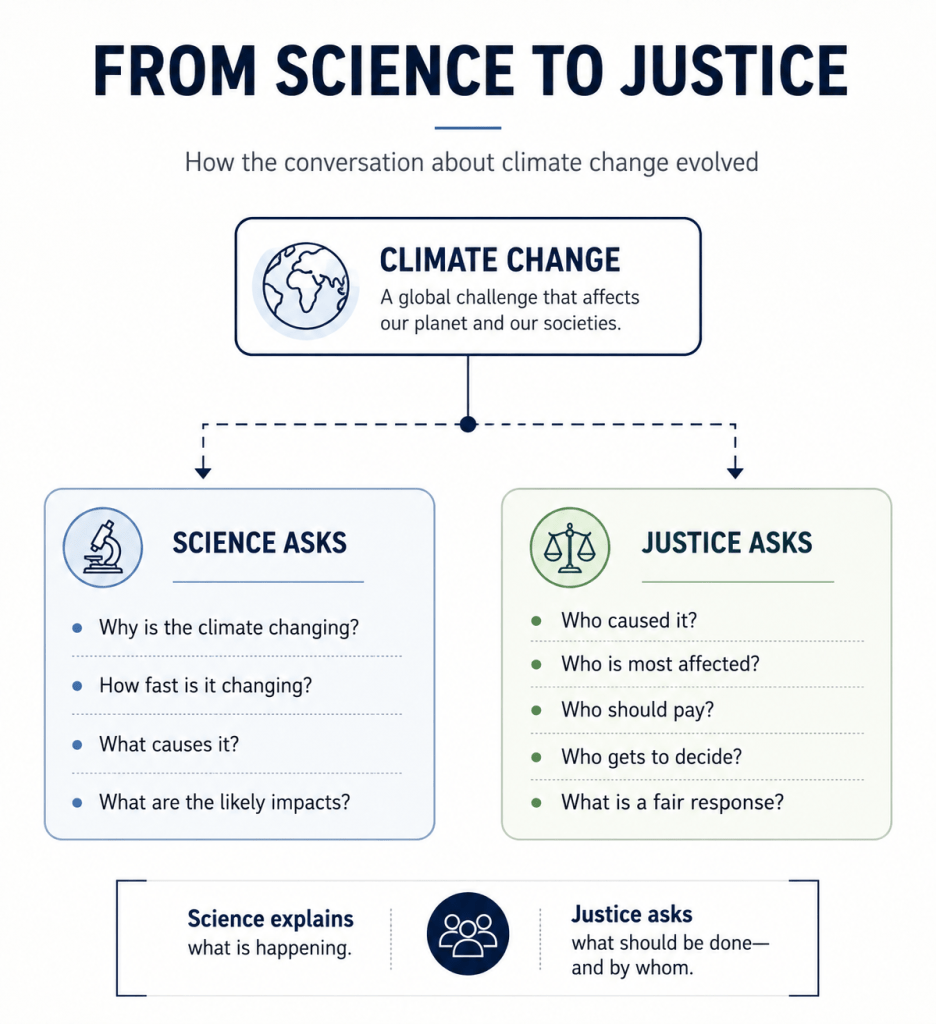
The answer is not that science became less important. Quite the opposite. The science became increasingly convincing. What changed was the kind of questions people began asking. Instead of asking only how is the climate changing?, they increasingly asked who is responsible?, who is affected?, and who should bear the costs of responding?
Those questions transformed the conversation.
Climate Change Is Older Than We Think
One common misconception is that climate change began with factories and fossil fuels.
It didn’t.
Long before humans built cities or burned coal, the Earth’s climate was already changing. Over millions of years, the planet has moved through repeated ice ages and warmer periods. Volcanic eruptions, shifts in Earth’s orbit, changing solar radiation, and the slow movement of tectonic plates have all influenced the global climate. In other words, climate change itself is neither new nor unusual.
How do we know this?
Not because anyone was around to record it, but because the planet has kept its own records. Ice cores drilled from Antarctica preserve tiny pockets of ancient air that reveal past atmospheric conditions. Tree rings tell stories about rainfall and temperature stretching back centuries. Sediment deposits, coral reefs, and fossil records allow scientists to reconstruct climates that existed long before human civilisation.
These natural archives tell us something important.
The Earth’s climate has always changed.
So why is today’s climate crisis different?
The answer is not simply that temperatures are rising. It is the speed at which they are rising and the cause behind that change.
Over roughly the past two centuries, the large-scale burning of coal, oil, and natural gas has released enormous quantities of carbon dioxide and other greenhouse gases into the atmosphere. According to the Intergovernmental Panel on Climate Change (IPCC), it is now unequivocal that human influence has warmed the atmosphere, oceans, and land. While natural climatic variations continue to occur, the current rate of warming is occurring far faster than most natural climatic shifts observed over comparable periods.
By the late twentieth century, the scientific debate had become remarkably clear. The question was no longer whether human activities were influencing the climate, but how societies should respond.
Notice, however, what the conversation was still centred on.
Scientists measured temperatures.
Governments negotiated emissions.
Economists estimated costs.
Engineers developed cleaner technologies.
Climate change was largely treated as a problem that could be understood through scientific evidence and managed through environmental policy.
Political theorist Andrew Dobson has argued that environmental politics originally focused on protecting ecosystems and managing environmental risks. Questions of justice entered later, when attention shifted from the environment itself to the unequal distribution of environmental harms and benefits. Climate change followed a remarkably similar path.
For years, the central question was simply:
How do we stop the planet from warming?
Eventually, another question emerged.
What if the warming isn’t affecting everyone equally?
That single question would fundamentally change how climate change was understood.
The First Question That Changed Everything
For much of the early climate debate, the atmosphere itself was at the centre of attention. Scientists were trying to understand how the Earth’s climate system worked, while governments were discussing emissions, energy, and environmental regulation. The underlying assumption was that climate change was a global environmental problem requiring a global environmental solution.
Then another question began to emerge.
If climate change is a shared problem, is everyone equally responsible for creating it?
That question may seem obvious today, but it fundamentally changed the conversation.
By the late 1980s and early 1990s, many developing countries began arguing that climate change could not be discussed without acknowledging history. Industrialised nations had spent nearly two centuries building their economies through the large-scale use of coal, oil, and natural gas. Those emissions accumulated in the atmosphere long before many newly independent or lower-income countries had industrialised themselves.
From this perspective, asking every country to reduce emissions in exactly the same way ignored a crucial reality: countries had not contributed equally to the problem in the first place.
Political philosopher Henry Shue was among the earliest scholars to articulate this argument. Writing in the early 1990s, Shue challenged the idea that climate obligations should simply be distributed equally among all states. Justice, he argued, requires looking not only at present actions but also at historical responsibility and unequal capacity. A country that has benefited economically from centuries of fossil fuel use occupies a very different position from one that has contributed relatively little to cumulative emissions while still struggling to meet basic development needs.
In other words, equality and fairness are not always the same thing.
From Science to Fairness
These debates gradually found their way into international negotiations.
The 1987 Brundtland Report, Our Common Future, had already introduced the idea that environmental protection and economic development could not be treated as separate issues. Sustainable development, it argued, required thinking about both together. Although the report did not use the language of climate justice as it is understood today, it helped shift international thinking away from purely environmental management toward broader questions about development, equity, and responsibility.
A few years later, these ideas became far more visible during the 1992 Rio Earth Summit, one of the largest international environmental conferences ever held.
Rio did not solve the climate crisis.
It did something arguably more important.
It changed the way governments talked about it.
The United Nations Framework Convention on Climate Change (UNFCCC), adopted at Rio, acknowledged that climate change was a common concern for all countries. But it also recognised something that remains central to climate negotiations today: countries do not enter the conversation from the same starting point.
This recognition became known as the principle of Common but Differentiated Responsibilities and Respective Capabilities (CBDR-RC).
The name is long.
The idea is surprisingly simple.
Every country has a responsibility to address climate change.
But not every country has the same responsibility.
Some have emitted far more greenhouse gases over time.
Some possess greater financial and technological resources.
Others remain far more vulnerable to climate impacts despite contributing relatively little to the problem.
Rather than treating every state identically, the principle attempts to balance two ideas that often pull in different directions: shared responsibility and historical fairness.
Not surprisingly, it has also become one of the most debated principles in international climate politics.
Justice Was No Longer Just About the Climate
Something important happened once responsibility entered the discussion.
The debate stopped being only about carbon.
It became about people.
Questions that had previously sat on the margins of climate negotiations moved closer to the centre.
Who has electricity- and who still doesn’t?
Can developing countries be expected to abandon fossil fuels before achieving the level of prosperity that wealthier countries already enjoy?
Should countries facing rising seas receive financial compensation for losses they did little to cause?
Can development itself be separated from questions of climate responsibility?
Economist and philosopher Amartya Sen has long argued that justice cannot be understood simply by looking at formal equality or abstract principles. What ultimately matters is what people are actually able to do and to be- their capabilities. Although Sen was not writing specifically about climate change, his work offers an important lens through which to understand why climate impacts cannot be measured only in degrees Celsius or tonnes of carbon dioxide. The same drought, flood, or heatwave may have profoundly different consequences depending on a community’s resources, institutions, and opportunities.
Climate change was beginning to reveal inequalities that had always existed.
It wasn’t simply creating new vulnerabilities.
In many cases, it was exposing and intensifying old ones.
The Debate Didn’t Stop at Countries
For a while, climate justice was discussed largely as a question between states.
Industrialised countries.
Developing countries.
Historical emitters.
Low-emitting nations.
Negotiations often revolved around familiar questions. Who should reduce emissions first? Who should finance adaptation? Who should compensate countries already experiencing irreversible climate loss and damage?
Those questions remain central today.
But over time, the conversation expanded.
People began noticing that climate change was exposing inequalities not only between countries, but also within them.
A flood does not affect everyone in the same way.
Neither does a drought.
Or a heatwave.
The hazard may be shared, but the consequences rarely are.
A family living in a well-insulated home with insurance, savings, and access to healthcare experiences climate risks very differently from someone living in informal housing without those protections. Farmers dependent on seasonal rainfall face different vulnerabilities from office workers in major cities. Coastal communities confront different realities than those living hundreds of kilometres inland.
The climate may be changing for everyone.
But vulnerability has never been evenly distributed.
Climate Change Doesn’t Create Every Inequality. It Often Reveals Them
This is perhaps one of the most important shifts in how climate justice is understood.
Climate change certainly creates new challenges.
But just as often, it exposes inequalities that already existed.
Communities facing poverty, discrimination, political marginalisation, or weak public services are frequently less able to prepare for climate impacts, recover from disasters, or influence the decisions that affect them.
In that sense, climate change acts less like an isolated crisis and more like a multiplier.
It magnifies existing inequalities.
This broader understanding gradually reshaped the meaning of climate justice. The question was no longer simply who caused climate change? It became who is most vulnerable to its impacts, and why?
That “why” matters.
Because vulnerability is rarely determined by geography alone.
It is shaped by housing, income, health, education, political representation, access to infrastructure, and social exclusion. Two communities living side by side may experience the same storm, yet recover at entirely different speeds because they begin from very different circumstances.
As organisations working on climate justice have increasingly argued, environmental risks cannot be separated from broader questions of social justice, development, and human rights. Climate impacts are experienced through existing political and economic structures rather than outside them.
Whose Justice Are We Talking About?
As more voices entered the conversation, climate justice became richer, but also more complicated.
Indigenous communities often frame climate justice around sovereignty, land, and the protection of traditional knowledge. Their concern is not only environmental degradation, but also the loss of cultural practices and ancestral relationships with land that cannot easily be measured in economic terms.
For many small island developing states, justice is closely tied to survival. Rising sea levels threaten homes, freshwater supplies, livelihoods, and, in some cases, the long-term habitability of entire territories. Their calls for climate justice are often inseparable from demands for international solidarity and meaningful financial support.
Others approach climate justice through the lens of labour and economic transition. As governments move away from fossil fuels, workers and communities dependent on coal, oil, and gas industries ask different questions. How can emissions be reduced without leaving entire regions behind? What responsibilities do governments have toward workers whose livelihoods depend on industries being phased out?
Still others emphasise gender, disability, race, migration, food security, or public health.
Each perspective highlights a different dimension of what justice requires.
None captures the whole picture.
One Idea. Many Meanings.
This is perhaps why climate justice has become such a powerful, and sometimes contested, idea.
Unlike concepts defined through a single legal treaty or universally accepted framework, climate justice has evolved through international negotiations, social movements, academic scholarship, court decisions, and the lived experiences of communities around the world.
As a result, there is no single definition that everyone agrees upon.
For some, climate justice begins with historical responsibility.
For others, it begins with human rights.
Some prioritise distributive justice- how costs and benefits are shared.
Others emphasise procedural justice- who gets to participate in decisions.
Still others focus on recognition justice, arguing that certain communities have historically been ignored, excluded, or rendered invisible in environmental decision-making.
These different understandings are not necessarily contradictory.
More often, they reflect different answers to the same question:
What would a fair response to climate change actually look like?
Political philosopher Nancy Fraser has argued that justice cannot be reduced to the fair distribution of resources alone. Recognition, representation, and participation also matter because people cannot pursue justice if their voices are systematically excluded or their identities are ignored. Although Fraser developed her framework in a broader context, it offers a useful way of understanding why contemporary climate justice debates increasingly extend beyond emissions and finance toward questions of power, inclusion, and decision-making.
In other words, climate justice is not simply about sharing burdens.
It is also about sharing voice.
Can Science Tell Us What Is Fair?
Throughout this discussion, one thing becomes increasingly clear.
Science can tell us that the planet is warming.
It can estimate how much sea levels might rise.
It can model future emissions pathways and calculate the likely consequences of different policy choices.
What science cannot do is decide what is fair.
It cannot answer whether countries that industrialised first should contribute more to climate finance.
It cannot determine whether communities displaced by rising seas deserve compensation.
It cannot tell governments how to balance economic development against environmental protection.
Those are not scientific questions.
They are political, ethical, and legal ones.
This distinction is important because climate debates often appear to be disagreements about scientific evidence when, in reality, many disagreements concern justice.
People may agree entirely on the science while reaching very different conclusions about responsibility, compensation, participation, or fairness.
Political philosopher John Rawls argued that questions of justice arise whenever societies must decide how benefits and burdens should be distributed. Climate change presents exactly this challenge, but on a global scale. The issue is no longer simply understanding environmental change. It is deciding how the responsibilities created by that change ought to be shared.
Perhaps this explains why climate justice has become such a central idea over the past three decades.
The science made action necessary.
Justice made the conversation far more complicated.
The Question We Are Really Asking
Climate change did not suddenly become a justice issue because the science changed.
The science became stronger.
What changed were the questions people began asking.
The conversation gradually moved from understanding the atmosphere to understanding responsibility. From measuring carbon to examining inequality. From asking how to reduce emissions to asking who should bear the costs of a changing climate, and who gets to decide.
That shift explains why climate justice continues to generate disagreement today.
People rarely disagree that the climate is changing.
They often disagree about what fairness demands in response.
Perhaps that is why climate justice has never settled into a single definition.
It was never simply a scientific concept waiting to be discovered.
It emerged because different communities, governments, scholars, and social movements began asking different questions about the same crisis.
And those questions continue to evolve.
So perhaps the more interesting question is no longer when climate change became a justice issue.
It is whether any meaningful conversation about climate change can now avoid becoming one.
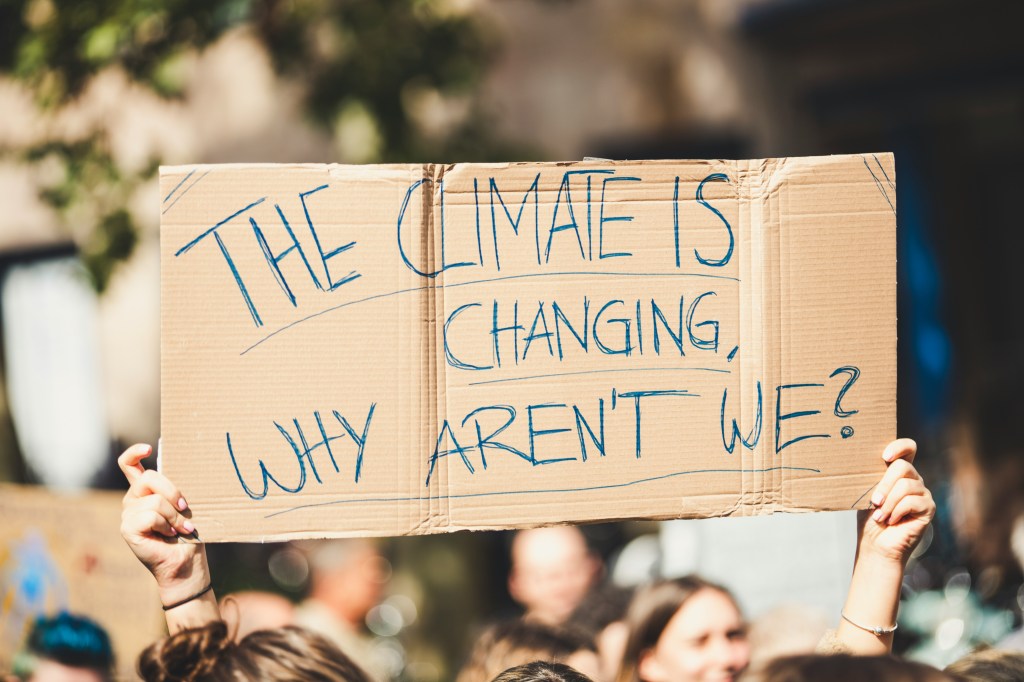
Featured image: Photo by Markus Spiske on Unsplash
 Public Praxis Forum
Leave a comment